
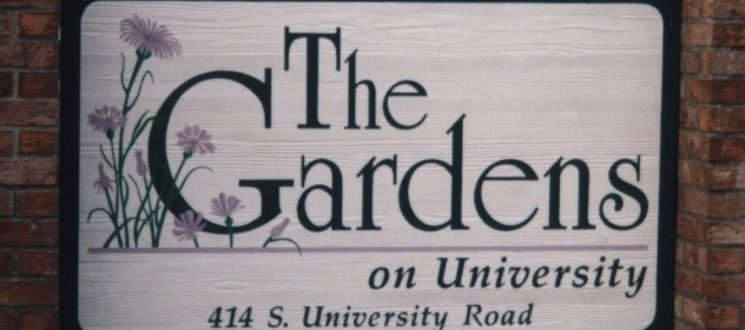
Most of you reading this article probably will never make sandblasting signs, but if you want to know about the process of making them, this article will be very informative in that regard.
In about 1870, Benjamin C. Tilghman invented and patented a method that used high-pressured air to powerfully drive an abrasive substance against wood or other surfaces to remove paint, moss, dirt, or, in the case of sandblasting, wood particles. We’re not precisely sure how long it took makers to adopt this method to create the first wood sandblasted display, but because carved wooden signs had been in existence for thousands of years, it was not long before an enterprising producer figured out that this process could, with a “blast mask,” be adapted to sandblast displays.
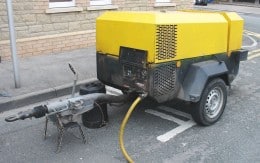
In approximately 1932, Wheelabrator patented a new method using the centrifugal force of a wheel to impel abrasives against a target, such as a signage. This method is typically known today as “airless” sandblasting. This system of uses recyclable steel or grit particles to blast the item at hand. These machines vary in size, depending on the type of work the company performs. The larger machines aren’t typically necessary.
How to Choose the Right Materials to Make a Sandblast Sign
There are two major materials used in the 21st Century in the making process, and a third material that is making inroads:
WOOD
Wood, logically, was the first material used, and is still widely used today. With wood, typically we prime it, then apply a “blast mask,” then blast the sign with an abrasive. The soft part of the grain is blasted away with an abrasive as described above.
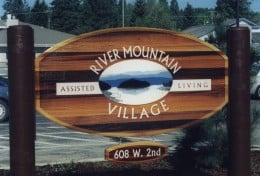
The two main types of woods used in sandblasting signs are Western Red Cedar and Redwood. These are both beautiful softwoods that are at their most attractive when their natural beauty is allowed to show through. The signage to the right is an example of a hand-painted and natural wood-grained made of Western Red Cedar, indigenous to the region where this is placed near the Idaho border in NE Washington State. Incidentally, your’s truly painted the centerpiece.
The drawbacks of this type are several. High maintenance is the main complaint, particularly if one has natural wood grain as the display above has. Because wood expands and contracts seasonally, it tends to wick moisture through any paint or stain or sealant when micro-fracturing occurs in the paint due to this expansion and contraction. Once moisture gets behind the paint, it will tend to work paint loose along these micro-fractures, and the signage will begin to shed paint over a 3 to 10 year period, depending on the severity of the climate, sunlight, and other weather factors.
HIGH DENSITY URETHANE (HDU)
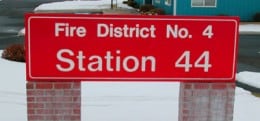
In the past couple of decades, a new material began to be used increasingly. High Density Urethane, or HDU, is a synthetic product that mills easily, is unyielding to inclement weather, more dimensionally stable, bug-proof, and can be textured using a wire frame to look like wood. One drawback is that if you want a natural wooden look, you cannot use HDU. Another is that HDU does dent somewhat easily, especially with a faux wood grain. Most of the time this is not a significant issue.
A friend of mine makes wholesale sandblasted signs and introduced me to a new material a while back called Extira™. You need to know, for starters, that I make no direct commission from this material, and the margins are pretty much the same as the previous two items. We’ve just been impressed with the durability of this dense man-made wood and resin product.
Extira™ has the advantages of HDU such as rot and bug resistance due to the zinc borate treatment in the manufacturing process, and is dimensionally stable like the urethane panels. It is also very heavy, which is an advantage in that it is a denser, stronger material than HDU or wood. The only semi-negative is that it comes in a 1.25″ thickness, so appears to be less solid than 2″ thick HDU or 1.5″ thick wood.
Extira™ also scores well in the “green” department. It is made from sustainable materials, but no old growth wood, which is one of the negatives for some clients with redwood and cedar. It is manufactured without the use of added urea formaldehyde as HDU is. HDU is also an oil-based product, so it’s not what we’d consider an environmentally friendly product. And Extira™ has a Class C fire rating, along with a five year warranty. As for pricing, it’s about the same as the other options. HDU and Extira™ are both less costly than redwood or cedar now, and are roughly the same price.
Now that you know how to sandblast wood signs or similar, and you know what materials to use, you can get online and find a good company with a good BBB rating and make an order. Or, if you’re really adventurous and want to go into this kind of business, you’ve at least got some of the basics of making right here. Good luck!
For more information regarding sandblasting signs, visit here.
If you have questions or anything to add about sandblasted signs, leave a comment at the bottom of this page.
 (1 votes, average: 5.00 out of 5)
 Loading...
Popular Posts:



